

On April 7, a research team led by Professor Chang Yunfei from the School of Instrumentation Science and Engineering of Harbin Institute of Technology (HIT), in collaboration with institutions including Xi'an Jiaotong University, The University of New South Wales (Australia), and the University of Wollongong (Australia), achieved a significant breakthrough in high-performance textured piezoelectric ceramics. The research results, titled Lead zirconate titanate ceramics with aligned crystallite grains, were published in《Science》.
Piezoelectric materials can realize the mutual conversion between mechanical energy and electrical energy, and are in wide demand in important fields such as medical ultrasound diagnosis, precision drive control, deep-sea communication, and non-destructive testing. Lead zirconate titanate (PZT) ceramics are the core material of many electromechanical conversion devices, and enhancing their piezoelectric performance is of great significance for promoting the upgrading and upgrading of related devices and systems.
Texturing ceramic grains (i.e., aligning grains along specific crystallographic directions) to give full play to the anisotropy of grain physical properties is considered a key approach to further improve the piezoelectric performance of PZT ceramics. However, since the 1990s, it has been impossible to prepare textured PZT ceramics with highly preferred grain orientations. Specifically, before ceramic texturing, PZT powder undergoes a severe solid-state reaction with traditional titanate microplatelet templates, making the templates unable to guide the oriented growth of grains, which has become a key problem plaguing the texturing of PZT ceramics.
To address the above issues, the research team proposed a research idea to achieve high-quality texturing of PZT ceramics through passivated templates. On the one hand, the team developed a new Zr⁴⁺-containing Ba(Zr,Ti)O₃ template to replace the traditional titanate template, improving the stability of the template in the matrix; on the other hand, the team designed a multi-layer structure of PZT matrix with non-uniform Zr⁴⁺ content to replace the traditional uniform structure, enabling the template seeds to first complete the task of inducing oriented grain growth in the PZT matrix with low Zr⁴⁺ content. During the subsequent grain growth and ceramic densification process, uniformly composed textured PZT ceramics are obtained through the diffusion of Zr⁴⁺ and Ti⁴⁺.
Based on the above method, the research team solved the academic problem that PZT ceramics cannot be textured with high quality for decades, and for the first time prepared textured PZT ceramics with grains highly preferentially oriented along the <001> direction (Fig. 1a & b). Excellent piezoelectric and electromechanical coupling properties (piezoelectric coefficient d₃₃ ~ 700 pC/N, g₃₃ ~ 90 mV·m/N, electromechanical coupling coefficient k₃₃ ~ 0.85) and good temperature stability (Curie temperature ~ 360℃) were achieved near the morphotropic phase boundary, breaking the restrictive relationship between the piezoelectric effect and Curie temperature of existing PZT ceramics (Fig. 1c).
This study provides a new idea for the texturing of advanced ceramics. The developed high-performance textured PZT ceramics not only bring new opportunities for improving the performance of high-sensitivity sensors and transducers, but also provide important basic materials for studying the structure-property relationship of classic ferroelectrics such as PZT.
The co-corresponding authors of the paper are Professor Li Fei from Xi'an Jiaotong University, Professor Chang Yunfei from our university, and Professor Zhang Shujun from the University of Wollongong (Australia). The co-authors of the paper include doctoral students Liu Linjing and Lü Rui from the School of Instrumentation Science and Engineering of our university. The research work was supported by projects such as the National Natural Science Foundation of China and the National Key R&D Program of China.
Paper link: https://www.science.org/doi/10.1126/science.adf6161
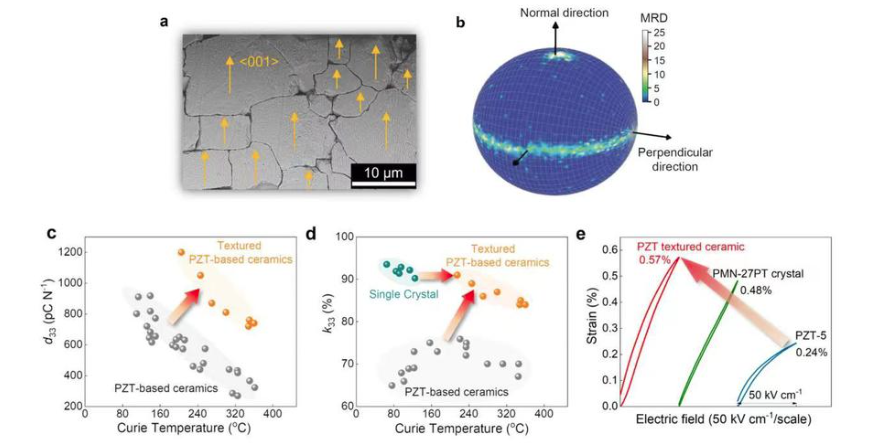
Fig. 1. (a) Cross-sectional scanning electron microscope image of textured PZT ceramics;(b) Synchrotron radiation XRD {002} pole figure of textured PZT ceramics;(c) Relationship between piezoelectric coefficient d₃₃ and Curie temperature of textured PZT-based ceramics and traditional PZT-based ceramics;(d) Relationship between electromechanical coupling coefficient k₃₃ and Curie temperature;(e) Comparison of electrostrictive strain between textured PZT ceramics, <001>-oriented PMN-27PT single crystals, and commercial PZT-5 ceramics.