

HIT Multimedia (Liu Peixiang, Zhang Delong / Text; Zhang Delong / Images) Recently, a research team led by Professors Chang Yunfei and Wang Dawei from the School of Instrumentation Science and Engineering and Zhengzhou Research Institute of Harbin Institute of Technology (HIT) proposed a synergistic design strategy involving the introduction of 2D bismuth layer-structured ferroelectric micro-sheets into the matrix and the construction of a bilayer composite structure. This breakthrough overcomes the limitations of polymer-based dielectric materials in improving energy storage performance. The related research results, titled Superior energy storage capacity of polymer-based bilayer composites by introducing 2D ferroelectric micro-sheets, were published in Nature Communications.
Polymer-based dielectric capacitors exhibit advantages such as fast charge-discharge rates, high power density, good flexibility, and self-healing capabilities, playing a crucial role in energy storage devices and advanced electronic power systems. However, polymer-based dielectric materials face challenges including low breakdown strength, low dielectric constant, and high electric hysteresis, making it difficult to simultaneously achieve significantly improved energy storage density and efficiency. This has hindered the development of related devices and systems toward higher performance, miniaturization, and lightweighting.
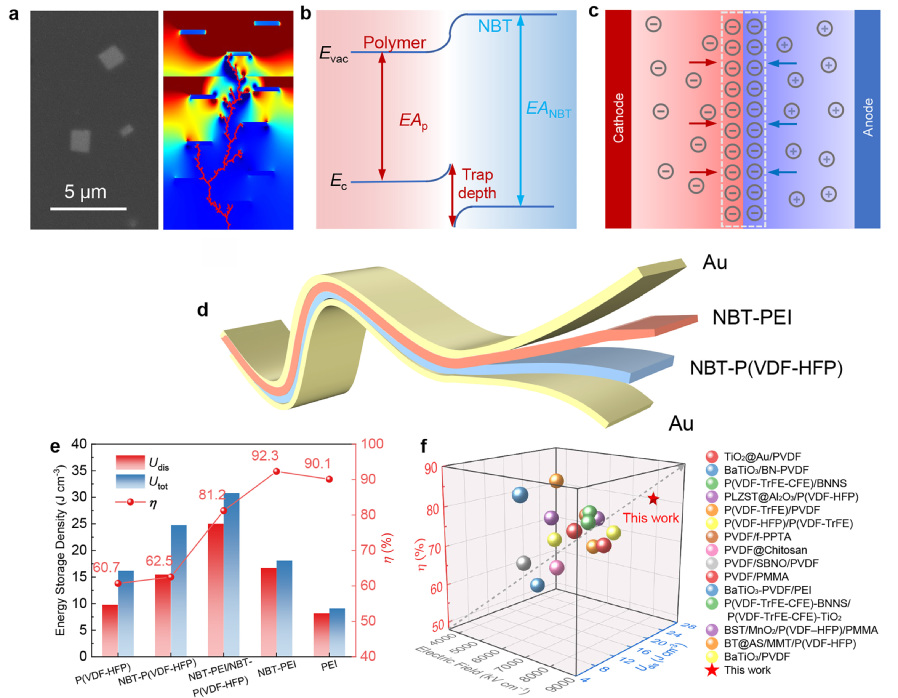
Achieving High Energy Storage Performance of Polymer-Based Composites via Introducing 2D Ferroelectric Micro-Sheets and Constructing Bilayer Structures
To address this issue, Professors Chang Yunfei and Wang Dawei's team proposed a design concept involving the incorporation of 2D bismuth layer-structured ferroelectric Na₀.₅Bi₄.₅Ti₄O₁₅ (NBT) micro-sheets into the polymer matrix and the fabrication of a bilayer composite structure (Fig. d). By synergistically leveraging the electric potential barrier effect from the NBT micro-sheets and the interface effect from the bilayer structure (Figs. a-c), charge transport within and between polymer layers is effectively suppressed, leading to a substantial enhancement in breakdown strength. Additionally, this strategy improves the dielectric constant of the polymer and enhances its polarization capability. The developed bilayer polymer-based composite NBT-PEI/NBT-P(VDF-HFP) achieves a significantly improved energy storage density(Udis~25.0 J/cm3) while maintaining a high energy storage efficiency (η ~81.2%). This work provides important guidance for the future development of high-performance polymer-based dielectrics and offers a high-performance polymer-based energy storage material for advanced energy storage devices and system applications.
The School of Instrumentation Science and Engineering of HIT is the first completing unit of the paper. Professors Chang Yunfei, Wang Dawei (HIT), and Professor Zhang Qingfeng (Hubei University) serve as the corresponding authors. Fan Zhenhao, a doctoral student from the School of Instrumentation Science and Engineering, is the first author. Doctoral students Dai Jian, Xie Hang, Yue Wenfeng, etc., also participated in the related research.
Paper link:https://www.nature.com/articles/s41467-024-55112-1