

Reprinted from Guangming Daily: [The People Need Such Scientists No.27] Strive for the Pinnacle or Nothing at All
By Shiying Zhang, Jianing Zhao (Reporters)Guangming Daily (January 18, 2026, Page 01)
[The People Need Such Scientists No.27]
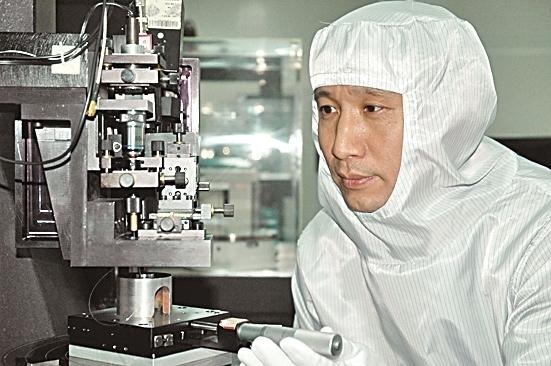
Jiubin Tan
At the award ceremony for the Models of Longjiang honor in Heilongjiang Province at the end of 2025, when the host announced the name of Academician Jiubin Tan, a tidal wave of applause surged toward the composed and simply dressed scientist standing at the front of the stage.
Challenge cutting-edge technologies, serve the country with precision instruments, and in the future, we will scale new heights in world science and technology once again! Tan’s words were plain yet powerful, a belief that has taken root in the heart of this researcher for nearly half a century.
Precision instruments are the eyes of scientific exploration and the rulers of high-end manufacturing. The pursuit of nanometer-level precision is a contest that bears on a country’s scientific and technological strength, manufacturing capacity and even strategic security.
With 48 years of dedicated research in ultra-precision measurement and instrument engineering, Jiubin Tan, Dean of the Institute of Precision Instrument Engineering at Harbin Institute of Technology (HIT), has led his team to create numerous first-of-its-kind instruments, breaking foreign technological monopolies step by step. The ultra-precision measuring instruments and testing equipment developed under his guidance have solved measurement challenges in the R&D and production of more than 30 high-end and sophisticated pieces of equipment including China’s ultra-precision manufacturing equipment and high-performance satellite cameras, propelling China to the forefront of the world in related measurement fields.
Young people are full of drive – strive for the pinnacle or nothing at all. Only by challenging cutting-edge technologies can we serve the country with precision instruments. This is what Tan often says, and it is also the path he has taken.
In the early 1990s, the country’s R&D of advanced equipment was in urgent need of a large cylindricity measuring instrument. Due to the high technical index requirements and tight development schedule, many domestic experts and teams backed down after assessment.
When the university turned to Tan, the young scholar who had just obtained his doctorate replied without hesitation: I can do it!
He took on the task, but the actual conditions were extremely harsh: the research group had only three members including him, no laboratory, and even borrowed desks.
As soon as the students’ experimental classes ended, we hurried into the room, moved the instruments off the desks and drew blueprints around them. When the class bell rang, we restored everything to its original state at once and moved to the corridor to find a place to continue our discussions... Tan recalled.
In the implementation phase, the university tried every means to allocate a laboratory to the research group. The 11-square-meter room was so cramped that one could barely turn around after placing the instruments and equipment. But Tan was content: Finally, we have our own ground to stand on.
In 1995, China’s first large-scale special precision instrument was born right here.
The initial success made Tan extremely sober: ultra-precision instruments are core technologies urgently needed for national development – they cannot be bought or bypassed. We must lay a solid foundation of technological accumulation and deliver tangible, high-quality achievements. He resolutely set his direction: focus on ultra-precision opto-mechatronic integration instrument engineering, benchmark international first-class standards, and challenge the cutting edge!
It was no easy road. At that time, most domestic research in this field focused on publishing papers, while few paid attention to the key technical problems in engineering applications. Catching up with the advanced foreign level seemed like a fantasy.
If even we don’t do it, who will fill this gap? Our research may not yield results in a short time; it may take more than a decade or even decades of hard work. We must have the perseverance to stick to the task despite loneliness and hardship. Tan’s words were calm, yet resounding like metal striking stone.
Countless sleepless nights were spent in setbacks and restarting. Bit by bit, the team gnawed through the hard bones, and finally gained the strength to compete head-on with the world’s top level in the field of ultra-precision special shape measurement. China’s first reference-grade cylindricity measuring instrument developed based on new principles outperformed international authoritative metrology institutions in multiple indicators in comparative tests, and was adopted as a national metrological standard device.
Eighteen years of painstaking efforts bore fruit. In 2006, Tan’s team won the First Prize of the National Technological Invention Award. Since then, he has led the team to make continuous breakthroughs in the measurement of micro-apertures with large depth-diameter ratios and air-magnetic isolation micro-vibration technology, winning the Second Prize of the National Technological Invention Award twice.
Those who know Tan well call him a workaholic. Junning Cui, Dean of the School of Instrument Science and Engineering at HIT, still remembers that the first question Tan, his supervisor, asked during his postgraduate interview was: Can you endure hardship and dare to accept challenges?
There are no weekends or holidays in the laboratory. It took me a long time to adapt to such a work intensity. But Teacher Tan still works almost all year round – if he is not on a business trip, you can always find him in his office or the laboratory, Cui said.
This perseverance is more reflected in Tan’s extreme pursuit of details.
There is no shortcut to overcoming difficulties and solving tough problems. Pengcheng Hu, Vice Dean of the Institute of Precision Instrument Engineering at HIT, has a vivid memory of the first lesson his supervisor taught him: During a major scientific research project, a core sensor was basically developed, but there was always a slight interference in the signal – like a tiny splinter stuck in the flesh that we just couldn’t get rid of. A group of us young people tried various algorithms and struggled for months. We were really impatient and privately talked about how this little 'splinter' was actually harmless, so maybe we could just ignore it.
Ultra-precision measurement brooks no flaws at all. If we compromise on a tiny 'splinter' today, the high-end equipment we build tomorrow will be far inferior to others’. Tan led everyone to review the data repeatedly, trace the root cause, and improve the plan. He worked round the clock for several nights, his eyes bloodshot from fatigue.
In the end, the problem was pinpointed to an extremely minor grounding design. At the moment the problem was solved, Tan was as happy as a child: See? As long as we are tougher than difficulties, they will surely cower before us!
It is this spirit of relentless perseverance that has enabled Tan’s team to develop nanometer-level precision measuring instruments that have broken the long-term foreign monopoly, making China one of the few countries in the world to master this technology.
Engaging in scientific research is not only a career, but also a responsibility and mission that cannot be let down.
When communicating with young teachers and students, Tan often talks about his early scientific research experience: At that time, all the core instruments and equipment in the laboratory were branded with foreign names, and we used them with the utmost care. Because maintenance would cost a fortune, and we even had to swallow our pride to ask for it – core technologies were completely blocked from us. That sense of grievance was unforgettable...
If we don’t want to feel wronged, we have to strive for self-improvement! What foreigners can do, Chinese people can definitely do, and we can do it better! Inspired by Tan, a group of young and middle-aged teachers at the university have returned after studying at world-class universities or research institutions, devoting themselves to this lonely yet nation-defining cause.
Only by establishing a new generation of national measurement system and instrument industry system can we fundamentally form the capacity to support the construction of a strong science and technology country, a strong manufacturing country and a strong quality country. This is a huge systematic project that requires the continuous efforts of generations of instrument professionals. In recent years, Tan has spared no effort to advocate for this cause.
Every Spring Festival, a couplet written by Tan is posted at the entrance of the Institute of Ultra-Precision Optoelectronic Instrument Engineering at HIT – Nurse lofty aspirations, forge ahead through hardships to strive for national prosperity; Uphold great ambitions, tackle key problems with diligence to realize national rejuvenation.
These twenty-four characters fully embody his enduring and fervent belief in serving the motherland.
(Reported by Shiying Zhang, Jianing Zhao)
Interpreting a Scientist’s Responsibility with a Fiery Patriotic Aspiration
Reflection by Junning Cui
Dean of the School of Instrument Science and Engineering, Harbin Institute of Technology
It has been more than 20 years since I first studied and worked with Teacher Jiubin Tan as a postgraduate student. Once, I had a question in my heart: why has Teacher Tan maintained such a strong passion and drive for tackling key problems in ultra-precision instrument technology and cultivating innovative leading talents for decades, as if he is never tired and his steps of exploration never stop?
Later, I gradually understood – he regards his work as a duty and mission. It is this sense of mission that transcends personal struggle that keeps him always full of passion and strength. The longer I stay by his side, the deeper I feel the heavy sense of family and country in him.
Truly core technologies cannot be bought; they can only be broken through by ourselves. With this determination, Teacher Tan led the team to take the hardest path, enduring loneliness and hardship to delve into ultra-precision measuring instrument technology for decades, solving the pressing needs of major national projects.
To integrate the four characters of serving the country with precision instruments into our blood and continue to strive – just like Teacher Tan does – this is what we must do!