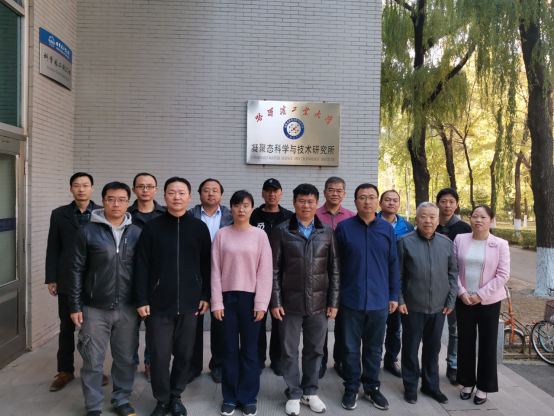
Historical Evolution: Founded in September 2011, the Institute of Precision Acousto-Optic Instruments (also known as the Institute of Condensed Matter Science and Technology) is affiliated to the School of Instrumentation Science and Engineering. It is a specialized research institute dedicated to the study of high-performance acousto-optic functional materials and precision acousto-optic instruments.
Faculty Team: The institute currently has 18 on-the-job staff members, including 7 professors, 1 distinguished researcher, 5 associate professors, 1 assistant professor, and 2 faculty postdoctoral researchers. Among them, 5 are recipients of national-level talent programs, 1 holds the Heilongjiang Provincial Outstanding Youth Fund, 1 is a Longjiang Scholar Distinguished Professor, and 1 has obtained the Heilongjiang Provincial Excellent Youth Fund. Up to 90% of the faculty members have overseas study experience and actively carry out international cooperation. The institute currently has a total of over 60 doctoral and master’s students.
Research Directions: Acoustic functional materials and precision measurement & control instruments, rare earth functional materials and devices, laser spectroscopy technology, nanomaterials and nanosensing, etc.
Representative Achievements:
(National 973 Program) Research on high-performance acoustic functional materials and their integration into high-end ultrasonic transducers.
(National Science and Technology Support Program) Development of new physical therapy technologies and suitable products for primary medical institutions.
(National Key R&D Program Projects) Development of high-performance ultrasonic transducers based on a new generation of acoustic functional materials; Research on comprehensive testing and evaluation technology for dynamic parameters of core components; Development of online monitoring equipment for SO₃ and sulfuric acid mist concentrations.
General Introduction: For years, the Institute of Precision Acousto-Optic Instruments has been committed to research in the field of acousto-optic information science and technology. It has built a research team with original innovation capabilities and high-level research competence, focusing on research directions such as multifunctional materials physics, oxide thin film materials, acousto-optic device design, precision acousto-optic instrument design and manufacturing, rare earth luminescent materials and their applications, and biomedical photonics materials and devices.
In recent years, the institute has undertaken and completed a number of major national, provincial and ministerial-level scientific research projects, achieving a series of important results. It has finished over 50 scientific research projects and won 1 Heilongjiang Provincial Natural Science Award (First Class). The faculty has published more than 700 high-quality SCI-indexed papers in prestigious journals including Nature Materials, Physical Review Letters, Advanced Materials, Advanced Functional Materials, Applied Physics Letters and Optics Letters, among which about 30 papers were published in journals with an impact factor greater than 10. The institute has also obtained approximately 40 authorized national invention patents.
Based on applied basic research, the institute conducts full-chain research covering the preparation and performance characterization of new acousto-optic materials, R&D of new high-end acousto-optic devices, and design and manufacturing of acousto-optic instruments. It has established interrelated research directions, forming a complete and integrated scientific research chain that includes theoretical research, material preparation, performance testing and application development, as well as device design and instrument fabrication.
At present, the research achievements of various directions have exerted a significant influence in relevant domestic fields. In particular, the research direction of acoustic functional materials physics and devices has stepped into the leading ranks in China and demonstrated strong competitiveness internationally.
Director: Professor Bin Yang
Deputy Directors: Associate Professor Guicheng Jiang;
Associate Professor Enwei Sun