

From May 27 to June 1, a faculty-student delegation — composed of members from the Distinguished Doctoral Cohort and participants of the Undergraduate Global Navigator International Vision Enhancement Program from the School of Instrumentation Science and Engineering — paid a visit to INSA Lyon (National Institute of Applied Sciences of Lyon) in Lyon, France on an academic exchange.Headed by Mr. Wang Shunli, the delegation comprised 8 doctoral students and 15 undergraduates. During the visit, the delegation toured the CREATIS Medical Imaging Research Laboratory, and attended the 3rd International Conference on Image Processing and Artificial Intelligence (ICIPAI 2026) and the 6th Sino-French Workshop on Medical Image Analysis and Artificial Intelligence. They conducted in-depth academic exchanges with experts and scholars from China and abroad in cutting-edge research areas including medical imaging, ultrasonic imaging, AI-based image processing and precision measurement.
During their stay at INSA Lyon, the delegation visited the CREATIS Laboratory under the guidance of Lecturer Zhu Yuemin. CREATIS has long committed itself to interdisciplinary research spanning medical imaging, ultrasonic imaging, brain functional imaging, image processing and artificial intelligence, establishing a comprehensive research ecosystem that covers imaging equipment development, data acquisition, image reconstruction and intelligent analysis.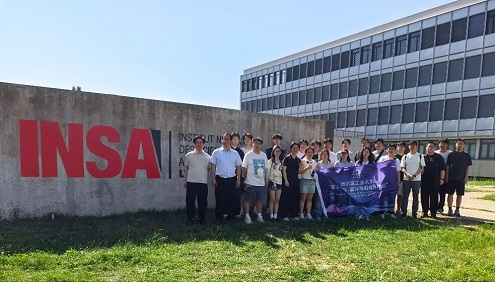
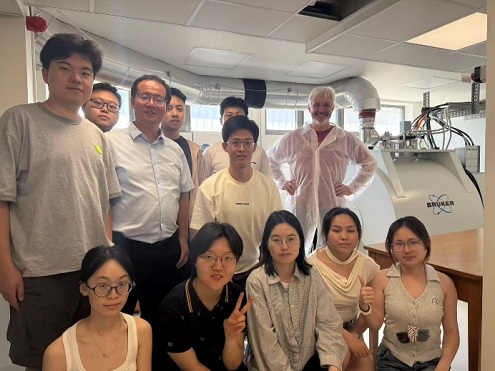
The faculty and students focused their visit on the 11.7T ultra-high-field magnetic resonance imaging (MRI) system, gaining thorough insights into its applications in imaging biological tissues and delicate brain structures of small laboratory animals. Ultra-high-field MRI enables acquisition of high-resolution tissue information in a non-invasive manner, laying a critical data foundation for research into disease mechanisms, brain science and medical image analysis. Through on-site briefings and exchanges, the group gained a clearer understanding of the close interconnections between high-performance imaging hardware, precision detection technologies and image processing algorithms.
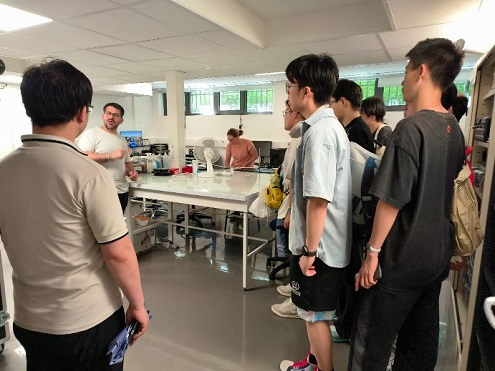
The delegation also inspected standard laboratory ultrasonic research equipment, gantry-type automated 3D ultrasonic scanning systems and raw ultrasonic data acquisition platforms. Researchers from the laboratory delivered detailed introductions covering ultrasonic signal collection, 3D scanning, image reconstruction and intelligent analysis. Specifically, the automated 3D ultrasonic scanning system leverages planar array probes and automated motion actuators to scan spatial regions and capture 3D structural data, while the raw data acquisition platform provides dataset support for ultrasonic imaging algorithm research, signal denoising and image reconstruction. Combining their respective research focuses in instrumentation science, precision metrology and image reconstruction, faculty and students held extensive discussions with laboratory researchers regarding equipment configuration, data acquisition schemes and algorithm implementation approaches.
Within the precision medicine and brain functional imaging experimental zone, the delegation learned about intraoperative malignant tissue detection devices as well as brain functional imaging systems integrating CMOS image sensors, phase demodulation and iterative reconstruction technologies. Such devices integrate multidisciplinary technologies including optical imaging, sensing detection, signal processing and image reconstruction, embodying the prevailing trend of deep integration between instrumentation hardware and artificial intelligence algorithms in modern medical imaging research. On-site communications broadened the faculty and students’ understanding of the applications of instrumentation science in life and healthcare disciplines, while inspiring new ideas for interdisciplinary expansion of relevant research directions.
Throughout the visit, the delegation took part in the 3rd International Conference on Image Processing and Artificial Intelligence and the 6th Sino-French Workshop on Medical Image Analysis and Artificial Intelligence, co-hosted by INSA Lyon and Shanghai Jiao Tong University. The conference centered on frontier research directions such as digital image processing, artificial intelligence algorithms, medical image analysis, intelligent computer-aided diagnosis and multimodal biological data fusion. Experts and scholars from China, France and other countries shared the latest research outcomes in these fields.
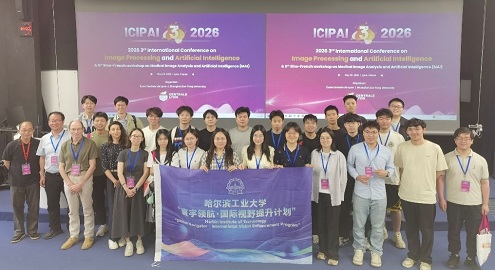
Members of the team delivered oral presentations at the conference based on their individual research topics, and exchanged views with attending specialists on research methodologies, technical roadmaps and practical engineering applications. By attending keynote speeches, thematic panel discussions and one-on-one academic dialogues, faculty and students updated their knowledge on advances of artificial intelligence in medical image recognition, segmentation, computer-aided diagnosis and multi-source data fusion, and deepened their comprehension of the interdisciplinary convergence of image processing, medical engineering, artificial intelligence and precision engineering measurement.
Doctoral candidates commented that this exchange not only offered a platform to showcase their research findings and keep abreast of global academic frontiers, but also helped them fully recognize that high-level scientific research must adhere to a problem-oriented mindset and integrate experimental validation with theoretical analysis. Undergraduates stated that visiting an international research laboratory, gaining hands-on exposure to state-of-the-art research instruments and participating in an international academic conference granted them intuitive perceptions of the full research workflow and the significance of interdisciplinary collaboration. The experience also clarified their future academic goals and career development paths.
This academic exchange trip to Lyon, France marks a key initiative by the Faculty of Instrumentation Science and Engineering to advance internationalized training for postgraduate and undergraduate students. The program has further broadened the global academic horizons of faculty and students, enhanced students’ capabilities in English academic presentation, cross-cultural communication and scientific critical thinking, and strengthened mutual understanding between the faculty’s research teams and relevant research groups at INSA Lyon. It delivers robust support for cultivating outstanding talents in instrumentation science equipped with global vision, innovative thinking and practical engineering capabilities.